
A reading above 50 denotes expansion while one below means contraction.

HSBC's purchasing managers' index was released on Tuesday.

'Rhetoric and chest-thumping are running high on India's recent growth record.'
'But will the giant waves developing elsewhere allow us to sail smoothly into fair winds?' asks Debashis Basu.

The BSA Gold Star is launched....Ola Enters e-motorbikes Biz... Bajaj, TVS To Enter e2Ws Market...

'While every year presents new challenges, it also provides opportunities for better growth and performance.'

Deloitte India on Friday said it estimates India's GDP growth at 6.6 per cent in the current fiscal helped by consumption expenditure, exports rebound and capital flows. In its India's economic outlook report, Deloitte said the rapid growth of the middle-income class has led to rising purchasing power and even created demand for premium luxury products and services. With the expectation that the number of middle-to-high-income segments will be one in two households by 2030/31, up from one in four currently, we believe this trend will likely become further amplified, driving overall private consumer expenditure growth, it said.

'Everyone confuses GDP to be a measure of output, when it is actually a measure of income.'

The country is gripped in an unprecedented economic downturn which is certainly going to spill over into the second half of this year unless the infection rate can be brought under control.

India's industrial production contracted by 3.6 per cent in February, official data showed on Monday. According to the Index of Industrial Production (IIP) data released by the National Statistical Office (NSO), manufacturing sector output declined by 3.7 per cent in February 2021. Retail inflation rose to 5.52 per cent in March, mainly on account of higher food prices, government data showed on Monday. The consumer price index (CPI) based retail inflation stood at 5.03 per cent in February.

'What's sad today is that there are so many people who cannot find work, not because the country is devoid of that opportunity, but because we are not doing enough in the country.'

India's industrial production growth decelerated to a four-month low of 2.4 per cent in July, mainly due to poor showing by manufacturing, power and mining sectors, according to official data released on Monday. The data showed that the previous low in industrial output growth was recorded at 2.2 per cent in March this year. IIP grew 6.7 per cent in April, 19.6 per cent in May and 12.7 per cent in June.
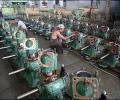
HSBC PMI falls to 50.7, slow domestic demand offsets pick up from abroad.

Get more people working, get more people working in modern manufacturing and services in our cities, and get people working better and longer, suggests Naushad Forbes, past president, CII.

Meanwhile, outlook for global emerging markets remained relatively weak in September.

Both manufacturers have sought funds in excess of Rs 150 crore under the department of biotechnology's Mission Covid Suraksha scheme. Announced last November, the scheme has an outlay of Rs 900 crore to help develop Covid vaccines, from the clinical development stage to setting up production sites.

Stock markets will be largely driven by global trends and macroeconomic data announcements in a holiday-shortened week which may see volatility amid monthly derivatives expiry, say analysts. Equity markets will remain closed on Monday for Gurunanak Jayanti. Trading activity of foreign investors and the movement of the rupee against the dollar will also be tracked by investors.

The Indian economy is likely to post better than anticipated growth in the second quarter (July-September) owing to robust urban consumption and expansion in services, a Business Standard analysis of high-frequency indicators showed. While gross domestic product growth in the September quarter is expected to come below the 7.8 per cent print in the June quarter due to a favourable base fading, analysts say the print will be much closer to 7 per cent than the 6.5 per cent anticipated earlier. While the Reserve Bank of India (RBI) had estimated 6.5 per cent growth for July-September, last month Governor Shaktikanta Das said the growth figure would surprise on the upside.

India's biggest car maker Maruti Suzuki said on Tuesday that its vehicle production in September will tumble by 60 per cent due to chip shortage. The company, which had earlier cut down production at its Gujarat plant, said the chip shortage will hit production in Gurugram and Manesar plants, effectively forcing the automaker to cut production by 60 per cent. Owing to a supply constraint of electronic components due to semiconductor shortage, the company is expecting an adverse impact on vehicle production in September in both Haryana and its contract manufacturing company, Suzuki Motor Gujarat Pvt Ltd. (SMG) in Gujarat.

The margins of tyre manufacturers could come under pressure given the rise in rubber prices and the moderating demand for tyres. In the past three quarters, the revenue growth for listed tyre companies has moderated from low to mid-single-digit on account of factors such as lower demand in replacement segments, weak export markets and the decline in the average selling prices to car makers (OEMs). Demand trends could remain muted in the near term, given the weak passenger vehicle replacement demand, assuming a typical replacement cycle of 3-5 years, and demand moderation in the OEM segment.

Indian growth in the rest of this fiscal year and next will be propelled by robust domestic consumption as consumer confidence improves, and by investment, including large increases in government capital expenditure, according to the Asian Development Outlook September 2023. "As slowing exports could foment headwinds for the economy, and erratic rainfall patterns are likely to undermine agricultural output, the growth forecast for FY2023 is revised down marginally to 6.3 per cent," ADB said.
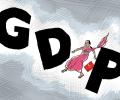
During the six-month period (April-September 2019), the Indian economy grew 4.8 per cent as against 7.5 per cent in the same period a year ago.

India's industrial production rose 19.6 per cent in May 2022, according to the official data released on Tuesday. As per the Index of Industrial Production (IIP) data by the National Statistical Office (NSO), the manufacturing sector's output grew 20.6 per cent in May 2022. In May 2022, the mining output climbed 10.9 per cent, and power generation increased 23.5 per cent.
India's industrial production grew in double digit for the second month in a row at 12.3 per cent in June mainly due to strong performance by manufacturing, power and mining sectors, according to official data released on Friday. However, the data showed that the industrial output growth is lower than 19.6 per cent recorded in May this year. It was 6.7 per cent in April.
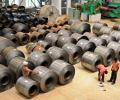
The IIP growth was 0.6 per cent as against 1.7 per cent in April last year.
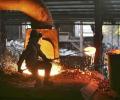
India needs to revive corporate sector investment, push critical reforms and remove infrastructural bottlenecks to boost industrial growth in the country, says a government document.

With an aim of boosting manufacturing and exports amid sharp fall in the rupee, the government has decided to take a slew of steps, including enhancing steel production capacity to 300 million tonnes and raising textile exports by 30 per cent this year.

Automaker to shift 200-300 workers from its Pantnagar facility to handle increased manufacturing.

Fitch Ratings on Thursday raised its forecast for India's economic growth to 6.3 per cent for current fiscal year 2023-24 from 6 per cent it had predicted previously. This is primarily because of a stronger outturn in the first quarter and near-term momentum. The growth forecast compares with 7.2 per cent GDP expansion in FY23. In the previous fiscal year (FY22), the economy had grown 9.1 per cent.

India's manufacturing sector witnessed a modest growth in May, but going ahead "weak demand conditions" may persist.
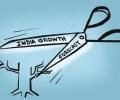
India's economy is projected to slow to 6.5 per cent in the fiscal year starting April but will remain the fastest growing major economy in the world as it fared better in dealing with the extraordinary set of challenges the globe has faced, the Economic Survey 2022-23 said on Tuesday. India's gross domestic product (GDP) growth of 6.5 per cent in 2023-24 compares with an estimated 7 per cent expansion in current fiscal year (April 2022 to March 2023) and 8.7 per cent in the previous year. Like the rest of the world, India too faced an extraordinary set of challenges in tightening financial conditions and supply chain disruptions from a prolonged war in Europe but "withstood them better than most economies", the annual document detailing the state of the economy said.

The sharp rise was also due to a statistical illusion -- low industrial numbers in November 2015, and sharp reversal of a 12-month declining trend in capital goods.
India's industrial production rose 3.1 per cent in September, according to official data released on Friday. As per the Index of Industrial Production (IIP) data by the National Statistical Office (NSO), the manufacturing sector's output surged 2.7 per cent in September 2021.
Industrial production growth slowed down to five-month low of 0.4 per cent in August mainly due contraction in manufacturing output and lower offtake of consumer goods.

The HSBC India Composite Output Index, which maps both services and manufacturing activity, fell to 48.4 in July, down from 50.9 in June, indicating an overall contraction.
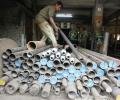
According to official figures, retail inflation in June touched its lowest mark at 7.31 per cent since January 2012.

Wipro was the biggest gainer in the Sensex pack, rising 4.34 per cent, followed by HCL Tech, UltraTech Cement, Tata Steel, Tech Mahindra, NTPC, Infosys, Power Grid, Tata Consultancy Services and State Bank of India. Mahindra & Mahindra, ITC, Axis Bank, Nestle, Kotak Mahindra Bank and Asian Paints were among the laggards.
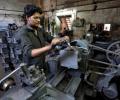
Industrial production grew 11.9 per cent in August mainly due to a low-base effect and good performance by manufacturing, mining and power sectors that surpassed the pre-COVID level. The manufacturing sector, which constitutes 77.63 per cent of the Index of Industrial Production (IIP), grew 9.7 per cent in August, according to the data released by the National Statistical Office (NSO) on Tuesday. The mining sector output rose 23.6 per cent in August, while power generation increased 16 per cent.

Sugar prices are hovering near six-year highs, leaving a bad taste in Indian consumers' palates but sweetening the portfolios of investors in related stocks at Dalal Street. Shares of sugar manufacturers such as Piccadily Agro, DCM Shriram, Magadh Sugar, and Bajaj Hindustan have rallied up to a whopping 200 per cent so far in the financial year 2024 (FY24) as deficient monsoon rains in major sugarcane producer states like Maharashtra and Karnataka are expected to lead to a shortfall in sugar output ahead. In comparison, the BSE Sensex has modestly gained 11 per cent during this period.
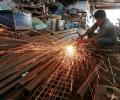
India's industrial production rose 1.9 per cent in March 2022, according to official data released on Thursday. As per the Index of Industrial Production (IIP) data released by the National Statistical Office (NSO), the manufacturing sector's output grew 0.9 per cent in March 2022. Mining output climbed 4 per cent, and power generation increased 6.1 per cent.

D&B sees January IIP to decline by 0.5-1.5 per cent. Last month the factory output, as measured in terms of the index of industrial production, had contracted by 0.6 per cent.
